Jorge at phdcomics.com is spot on again…
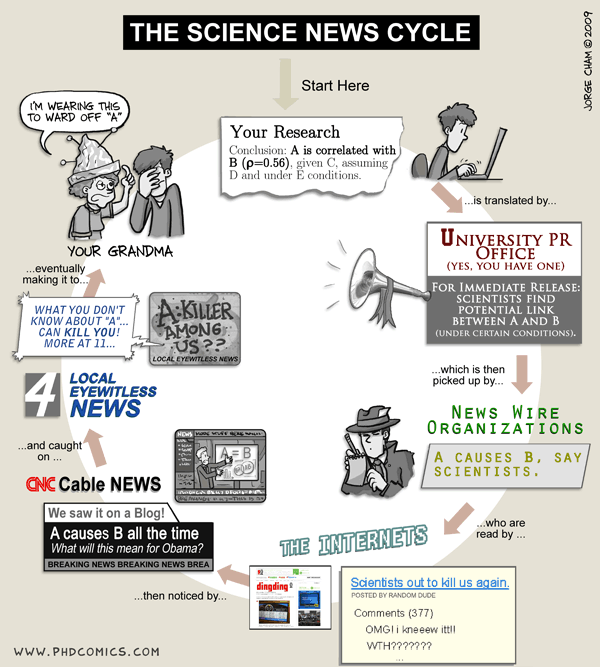
Here, for example, is a prime example.
by Jim Caryl
One of the joys of heading out into British woodlands in May is the profusion of Bluebells (Hyacinthoides non-scripta), an ebullient blue-purple woodland carpet, ‘like the blue sky, breaking up through the earth’ (Byron). The UK has 25% of the world’s population of Bluebells, and justly they’re a protected species – not to be picked, but to be enjoyed in their natural environment.

These pictures were taken in the Lake District on Saturday

[ratings]
 THE recent issue of Trends in Biochemical Sciences contained an interesting perspective piece from Alexander Shneider, PhD and CEO of CureLab in Massachusetts. He describes a revision, or alternative focus, of Thomas Kuhn’s (1962) theory of scientific (r)evolution. In this Shneider identifies four-stages of evolution through which a scientific disciple must pass to maturity:
Stage 1. The introduction of new objects / phenomena, with an accompanying language to adequately describe such phenomena.
Stage 2. Development of a ‘tool box’ of methods / techniques to probe the objects / phenomena; with advancements in methodologies helping to identify and understand the degree to which other phenomena fall into the realm of this new science.
Stage 3. The stage at which most of the specific knowledge is generated, with the majority of research publications being published, often focussing on the application of new research methods to objects / phenomena. Scientists may re-describe their subject matter using refinements from stage 2, in the same way that with the advent of molecular biology, biologists might re-describe old subject matter from this new context; thus creating new insights, new answers and new questions.
Stage 4. A seeming steady-state for a discipline, where the knowledge gained from earlier stages is is maintained and passed on, often with practical application; often with new means generated to present the information. Whilst ground breaking new discoveries are not necessarily made, this does not preclude crucial revisions to the role of this discipline within scientific environment.
 TODAY’S edition of Nature (14 May 2009) features a landmark paper from researchers at the University of Manchester School of Chemistry that describes the synthesis of a pyrimidine ribonucleotide from simple chemicals, which may have existed on an early Earth. The research by Matthew Powner, in the laboratory of John Sutherland, represents a major stepping stone in support of the ‘RNA World’ theory, which describes the origins of life as passing through a stage in which RNA was the sole mediator of inheritance and catalysis, i.e. no DNA or proteins.
You can learn more about RNA World theory at the Exploring Origins website, or via resources on the website of Jack Szostak, one of the pre-eminent leaders in the field who also presents an accompanying perspective in this edition.
Whilst RNA is certainly a versatile molecule, with one form or another capable of breaking itself apart, joining itself to other RNA molecules, promoting formation of peptide linkages (the primary links of proteins) and templating its own self-replication, a major limiting point has existed regarding the origins of the necessary precursors for the RNA itself, i.e. ribonucleotides. Since the late 60’s, chemists studying prebiotic chemistry have focussed on trying to identify conditions in which these ribonucleotides would spontaneously assemble from their constituent parts: a nucleobase (which can be adenine, guanine, cytosine or uracil), a ribose sugar and phosphate. However, this approach was based on the assumption that these sub-units would assemble first, before combining to form the ribonucleotides. Unfortunately, no realistic conditions have been found in which a nucleobase would join to a ribose sugar.
If there’s two things that people should know about me, its that I fold shirts and tie shoelaces a bit differently.
Periodically I feel compelled to post this video on how to fold t-shirts. I have been doing so for three-years now, on various blogs. So for those of you who don’t fold your t-shirts correctly, here is how it’s done.
As for tying shoelaces, well:
With a more detailed description of how to do so.
More science later folks.
[ratings]
Those familiar with one end of a biology text book from another will be aware that for the purposes of covenience/brevity/secret codes (take your pick), we use a one-letter and three-letter coding system for amino acids (the building blocks of proteins).
In a paper I must have read several times over the years, entitled ‘The liveliest effusion of wit and humor‘, the author Jan Witkowski describes some of the logic behind the one-letter codes:
The single letter amino acid code was devised in 1966 by an informal group led by Richard Eck, and the derivations of the letters are, for the most part, fairly clear [1]. For amino acids with a unique first letter, that letter is used; for example, I for isoleucine, M for methionine and V for valine. For amino acids with common first letters, that letter is used for the most common amino acid – A is used for alanine rather than aspartic acid, and L for leucine rather than lysine. That leaves a set of amino acids with a more cryptic one-letter notation. F for phenylalanine (Fenyalanine) and R for arginine (Rginine) are fairly obvious but why is W the letter for tryptophan? Eck explains this by stating that ‘tryptophan’ should be pronounced ‘twyptophan’ and, hence, ‘W’ is an appropriate symbol for it. The entry has an asterisk against it, leading the reader to a footnote: ‘My collaborators insist that I take full responsibility for this – R.V.E.’ Unfortunately, this explanation was omitted from later editions and ‘W’ is now supposed to represent the double ring system in tryptophan.
1. R.V. Eck , One- and three letter amino acid abbreviations: mneumonics of the one-letter notation. In: R.V. Eck and M.O. Dayhoff, Editors, Atlas of Protein Sequence and Structure xiii, National Biomedical Research Foundation (1966).
This leaves the infamous five amino acids that most 1st year biochemistry students forget: glutamic acid (E), asparagine (N), aspartic acid (D), glutamine (Q) and lysine (K).
Asparagine, at least, contains an ‘N’; glutamic acid results from the first syllable ‘gluE’; aspartic acid is best pronounced with a US accent, ‘asparDic’ (doesn’t work with an R.P. English accent). I have heard several reasons for why glutamine ended up with Q, and lysine with K (the latter of which is because K is close to L, which was already taken up by Leucine), but none really satisfy. None the less, they’re taught by rote and each generation of biochemists (et al.) is left to find their own reasoning.
The blogdom of skeptics has been in uproar over the ruling of Mr Justice Eady in the libel case Simon Singh vs British Chiropractic Association (BCA). The case has already been covered extensively, by The Lay Scientist (background | verdict) and Jack-of-Kent (background | verdict).
In Simon Singh’s book, ‘Trick or treatment: alternative medicine on trial’ (review by The Times here), he systematically addresses the pseudoscience of numerous alternative healthcare measures, including Chiropractry, about whom he said:
“The British Chiropractic Association claims that their members can help treat children with colic, sleeping and feeding problems, frequent ear infections, asthma and prolonged crying, even though there is not a jot of evidence. This organisation is the respectable face of the chiropractic profession and yet it happily promotes bogus treatments.”
The ruling hinged on Simon Singh’s use of the word ‘bogus’, which means counterfeit or fake, spurious, or bad. Unfortunately, when you start thinking about it meaning ‘counterfeit’ then this infers some degree of fraudulent use, or deliberate misuse, which is how the judge chose to rule in this case. Mr Justice Eady decided (evidently prior to the hearing had commenced) that the definition would be taken as consciously and deliberately dishonest. In this case it rules in the favour of the BCA where, by the judge’s own reasoning, Simon Singh has libelled them by labelling them deliberately dishonest. It seems strange that a judge can make any objective ruling on the definition of such a word in this case; Mr Justice Eady has effectively ‘cherry-picked’ the evidence by looking at the word ‘bogus’ within a paragraph, without including the evidential support of context from the chapter as a whole.
As I have discovered through word battles myself, different people lean towards different definitions of words when multiple definitions are available. An example might be ‘tautology’, which in one vein can be a rhetorical definition of ‘using different words to say the same thing twice’, yet can also have a meaning in logic of ‘a statement that is necessarily true’. What distinguishes the uses is the context in which they are used, and this seemed to be apparent in this case.
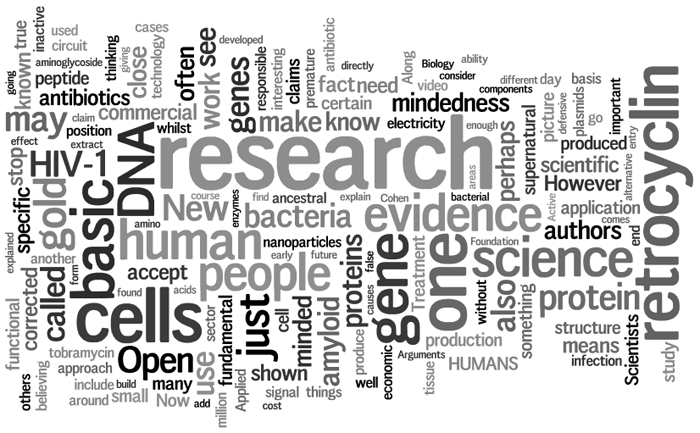
See what I’ve been writing about this month in one typographitastic image, courtesy of Wordle:
April
HUMANS, as we know, are the product of tens of thousands of genes, but hidden elsewhere in your DNA are genes that are no longer functional; these vestigial genes are known as pseudogenes, and they are ancestral remnants from an earlier point in our evolution. In many cases they are simply inactivated duplicates of a current functional gene. In other cases they are genes that have been cut out, reversed and stitched back in; in this position, some believe they may act to regulate the correctly oriented ‘functional’ version of the gene. Alternatively, they may be ancestral genes encoding functions that have become inactive beacuse they are ultimately not necessary for survival. Now, what if we could turn on one of these ancestral genes? One that could actually help protect us from a modern day infection?
In the recent edition of PLoS Biology is an interesting study that describes the re-activation of just such a dormant human pseudogene, retrocyclin, and its potential use as a defensive barrier against infection with HIV-1 (a strain of the Human Immunodeficiency Virus that causes AIDS). Retrocyclin is theta-defensin, which are naturally produced, circular chains of 18 amino acids (a peptide). I have previously research blogged about the application of other such antimicrobial peptides.
Active, functional theta-defensins have only so far been identified in the old world monkeys: the Rhesus Macaque and Olive Baboon; in Humans and other primates, they exist as pseudogenes. At some point in evolutionary history, our ancestors started inheriting a genetic mutation, all be it one that exists at 100%. The Human version of the gene, retrocyclin, is inactive in Humans because of a premature ‘stop’ signal, which makes the cell abandon the production of the peptide too early.
Retrocyclin can be synthesised chemically in a lab, and in this manner that the authors of this paper (from laboratories at the University of Central Florida and UCLA) have previously shown that it is capable of inactivating HIV-1, thereby preventing its entry into cells; in fact, they have also shown that it can similarly prevent entry of Herpes Simplex Virus type I (responsible for coldsores) and type II (responsible for genital warts).
[ratings]
TODAY ‘The Scientist’ reported that the UK government is going to bail out biotech, investing £750 million ($1.1 billion) to bolster this and other ailing commercial science and technology sectors. This isn’t a bad thing, per se, but at what cost?
Well perhaps it comes at the cost of ‘basic research’:
Government funding for basic research, however, will receive no additional funds. Buried deep on page 130 of the new budget, the government called on the public research councils, including the MRC and the Biotechnology and Biological Sciences Research Council, to reallocate £106 million ($154 million) of their pre-existing budgets to support key areas with predicted economic potential — a plan which leaves some science lobby groups less than happy.
They’re going to move money around, rather than putting more into the areas of basic scientific research. In contrast, the US government’s economic stimulus package has fed money into the National Institute of Health (NIH) and National Science Foundation (NSF), between whom most of my US scientist friends are funded in their basic scientific research.
But what do we mean by ‘basic scientific research’? The term, synonymous with fundamental or pure research, is first and foremost a quest for knowledge; it has no specific end goal or commercialisation, i.e. a practical application cannot be envisaged. We might also consider research that may yield a commercial application after 10 -50 years to be basic research too (I put my own current technologies work in this bracket). Applied research, in contrast, is work that is aimed directly at a specific commercial end, such as development of a particular drug.
So what’s the problem in the UK, why are we bothered?
 Mental Indigestion