Science 2.0…

INTERACTIVITY is key in the new Web 2.0 infrastructure, it’s what all the crazy cats are doing. The idea has now extended into the lecture theatre, with my university trialling a new system of student-lecturer interaction that one can only describe as ‘Lecture 2.0‘.

The particular technology being used is called Interwrite PRS, which is essentially a hand-held device lent to students for the year that can be employed to take part in impromptu quizzes and give feedback on the lecture. At the start of the lecture the students sign in using a key code, registering themselves with the computer at the front of the theatre. Points are awarded and recorded for both participation and for answering questions correctly.

Part of the aim is to get live feedback from the students; gone, hopefully, are the days when a question asked by the lecturer is met by a stony silence and a complete absence of hands being raised. It seems that generation X (or is it Y we’re on these days?) likes the anonymity of the web interface; and whilst it doesn’t necessarily address the need to be able to stand up in a crowd, it could in the long term engender greater confidence, and attention in lectures, as a result of participation.

One of the issues I wanted to raise around the Science Online London 2009 meeting is how we measure the impact of web-based science. Communicating science in the Web 2.0 infrastructure should mean that we can get real feedback on just how much people have understood what they read, or liked what they read. This isn’t to suggest that we start testing readers after every article of science writing.

We already have an open comments box, but in many respects this presents the horror of a blank piece of paper. Perhaps it would be worthwhile to construct an interactive feedback box that is more directed? Maybe something that is a third-party application that collates the feedback data from numerous science blogs? I’m sure there are plenty of tools out there in the blogosphere, but it would be nice to collate some independent data on the impact that science writers and science bloggers have.

In brief…(wry, ironic smile)

[ratings]

THIS weekend I will be attending the Science Online London meeting at the Royal Institution, where 150 delegates will be discussing science blogging and the nature of the web as a medium for the communication, practice and culture of science. It  also happens to be a year since I switched to my own installation of WordPress, and started what I’ve since referred to as a science blog. So I thought it might be a choice time to catalogue just some of the science I have been writing about in the past year.

LHC I started my ramblings last August, which was in time to comment on a report in Nature describing a virus that infects a virus, a virophage. The small virophage was called Sputnik, and it infects an enormous virus, called Mamavirus. This was an astounding piece of observational work, and having realised that such parasitism exists, and adjusted their views to the sizes of particles involved, the researchers reported that this phenomenon may be common in nature. Certainly, if parasitism is occurring at this scale, this may have major repercussions for what we understand about the biology and life-cycles of other important single-celled organisms that are also susceptible to viruses, such as algae. Algae are major players in the production of oxygen and fixing of carbon dioxide in the atmosphere, thus viruses that can (and do) infect algae could have indirectly influenced the state of our climate over the millennia.

Continue reading “In brief…(wry, ironic smile)”

10 year anniversary…

Graduation, University of WalesTHIS week has seen many graduation ceremonies at the university, all imbibed with veritable Hogwartian pomp. It makes me reflect on my own graduation, which curiously enough was exactly 10 years ago this week.

I was full of excitement in the event of getting my BSc. It meant a lot to me, I’d worked ‘fairly’ hard for it, I’d gotten a good grade and was ready to go off and try to be ‘a scientist’. I hadn’t yet figured out how I was going to do that; it would turn out that I would use do a Master’s degree whilst I decided what I wanted to do (which was in fact to go and do a PhD; how inventive of me).

The degree ceremony, held in both Welsh and English (it was the University of Wales after all), was excellent; they actually took the route less travelled and entertained us. There were musical recitals, an award winning Harpist, some meaningful words of wisdom and the usual traditional grandeur. No pulling of fingers or such silliness.

It is in stark contract to the format of the ceremony at my current university, at least five years ago when I graduated with my PhD, where they decided that the appropriate means to celebrate the achievement was to talk about how much research funding the university had received, and what a good job so-and-so vice chancellor was doing. No one cared, everyone just wanted to get their few seconds on stage and be off.

I was of course, like all newly minted graduates, full of cock and bull, ideological and desperately wet behind the ears. I’ve yet to meet a graduate who doesn’t think they know it all, but as is ever the case, within a year, most graduates realise they know nothing. As the brighter ones will admit, ‘the first step on the road to wisdom is admitting that you don’t know anything’; a derivation, I guess, from Socrates’, ‘The only thing I know, is that I don’t know anything’.

Ten years on and I’m still in contact with some of those with whom I graduated, all of whom seem to be doing well in their lives and careers. I remember being reticent to refer to myself as ‘a scientist’ at that time, being worried of being a fraud (an uncharacteristic display of graduate humility); yet I’m glad to say that I can now refer to myself as a scientist in the truest sense, which I think I would have been happy about back then.

Once again I am faced with a summer during which I will have to make some difficult decisions. Either I step up to the next rung of the ladder and become a lectureship somewhere, or I step to the side and find another way to ply my trade, all be it away from the bench.

Still, at least I feel confident saying that the only thing I know, is that I don’t know anything.

The creation of matter…

[ratings]

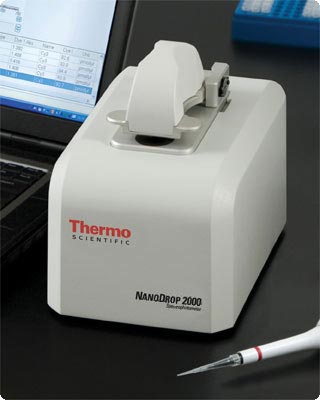
NanodropAT SCHOOL we learn that energy cannot be created or destroyed, it can only be converted. As matter is basically energy (revise E=mc2), then it follows that you cannot ‘create’ matter, it can only be converted.

Fortunately for us, we are lucky as a lab, for we have a Nanodrop that is able to achieve the impossible. The Nanodrop is a device used for measuring the concentration of biomolecules such as DNA, RNA and proteins, based upon the degree to which they absorb different wavelengths of light. All labs have such a device, but not all labs have the much lauded Nanodrop.

So when you’ve been labouring in the lab to purify DNA or protein, you then skip down to the Nanodrop in order to determine just how successful your preps have been. However, joy turns to dismay when upon clicking the special ‘Measure’ button on the computer software that powers the Nanodrop, the small value you see tells you that you have very little material; that in fact, you’ve wasted your time.

No longer though, because on our Nanodrop, if you press the magic ‘Measure’ button again, the value increases. In fact, each time you press the ‘Measure’ button, the value continues to grow. Keep doing this enough and you arrive at the kind of value that you were hoping for. With a few mere clicks of a keyboard we can quadruple the amount of DNA or RNA in our sample; an amazing feat given that there is no source of the raw materials needed to create the extra matter.

It really is the most impressive machine in the world ;-p

[update: following this post I was contacted by a representative of Thermo Fisher Scientific (formerly NanoDrop Technologies), to describe why we see the problem. The problem, it seems, is in the Chinese whispers by which one is taught to use the machine. It appears that one is only supposed to take one reading of any sample; repeated measures of the same sample show an an increase in absorbance over time as the 1-2 ul sample, being so small, evaporates – yielding a more concentrated sample. So there you go folks, quite logical really – you still can’t create matter; the search goes on.]


Artistic breaks…

Final_smallI’VE had a long weekend away, re-kindling my artistic proclivities by staying in a yurt on the edge of a moor in the Preseli Hills of Pembrokeshire; also the source of the blue stone used to build Stonehenge. It is an ancient landscape of winding roads, erratic stones strewn across the landscape, burial barrows, stone circles and various other random dolmens. Overwhelmingly Pembrokeshire is defined by its patchwork of green fields that hug the coastline right up to the lips of the characteristic Pembrokeshire cliffs.

On the way down to Pembrokeshire was Aberystwyth, home to the sister of my alma mater university, and also home to a fine promenade (see pictures below), great cafes, and delicatessens. Also not far from Aber is Machynlleth and the Centre for Alternative Technology (CAT). When I first visited the CAT 12 years ago, on a university field trip, green technologies were bulky, poorly commercialised and required a significant commitment to implement. However, times have changed, and it’s never been easier, or cheaper, to make the change to green energy, water and waste recycling, and sustainable lifestyles. The CAT is looking a little dated in some areas (most notably the rickety old water-powered funicular, which isn’t exactly a technology that should be rickety), but in other areas it has continued to grow, develop and implement newer green technologies.

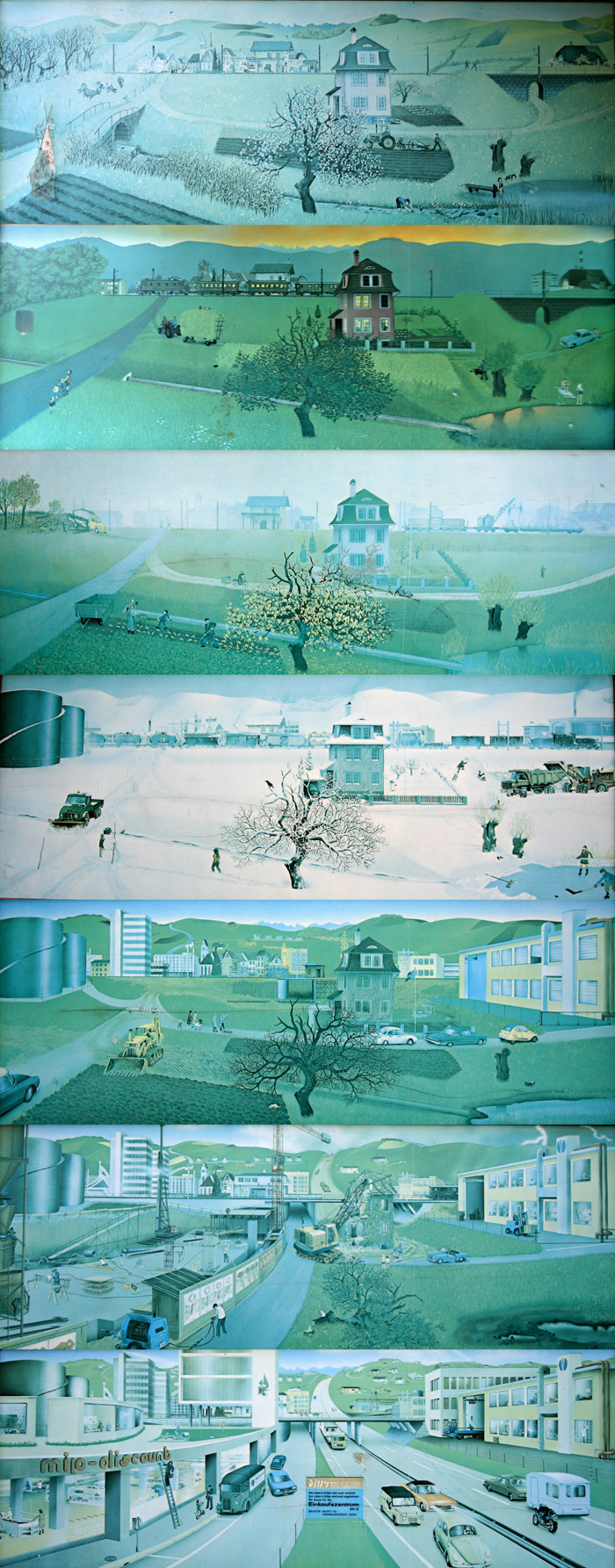
One thought-provoking CAT display is a pictoral time-lapse of landscape (mis-)development between 1953 and 1975, with obvious connotations of the negative impact of urban development. I photographed them and reassembled them here, which is the image on the left of this post.

Also at the CAT I discovered the Small House Society, something I’m sure has been rather more successfully promoted in the USA, but alas has received little notice over here. Spending time in a yurt, with a small adjoining shed containing a mini kitchen and shower, a hay bail to piss on and another small shed containing a sawdust toilet pit, it makes you wonder just how much space we really need. I guess the point it, if you live in a beautiful place, then sacrificing your living space isn’t too much of a chore; if you’re trying to ‘get back to the garden’ in a Joni Mitchell sense, then surely it’s better to have more garden than house? It’d be nice to see more communities of small (<300 sq yd) houses, rather than sprawling urban ribbon development.

Speaking of the yurt, on the same grounds was a pottery studio where I learnt to ‘throw a pot’, which is apparently pottery parlance for the making of a pot using a wheel. I have subsequently returned home with several new dishes, some random small pots, a coffee mug, a milk jug and a strong desire to add ‘Potter’ to my long list of alternative creative career options.

Four days isn’t really a lot of time to see everything, and rather than bore readers with a long account of a destination that you are better off visiting, rather than reading about, here are a few taster photos:

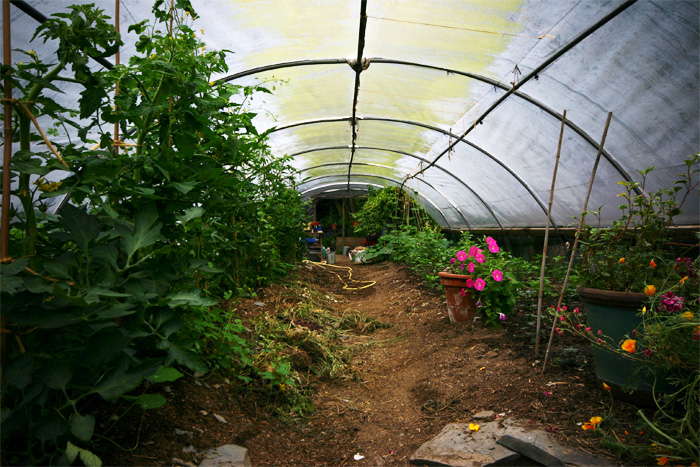
Traditional barn roof, mid-Wales Polytunnel at the Centre for Alternative Technology, Machynlleth, Powys Potting table, CAT, Machynlleth, Powys

Garden waste stove put to multiple uses, CAT, Machynlleth, Powys Aberystwyth promenade, Aberystwyth, Ceredigion. Aberystwyth pier

Aberystwyth beach jetty Book shop next to the Old Merchant House, Tenby, Pembrokeshire Brooding sky above an otherwise sunny Tenby beach

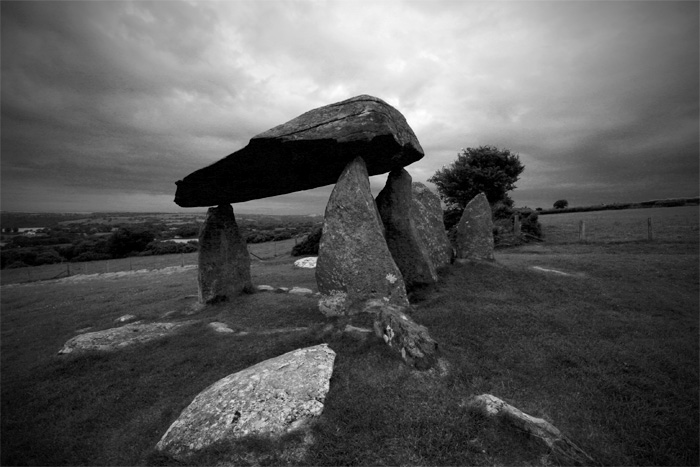
Lifeguard flag, Tenby beach One of my first thrown dishes Pentre Ifan burial chamber, erected 3,500 BCE!

I will add to these as and when I make headway through the seveal hundred captures I made!

iDon’tTouch…

[ratings]

Koi pond WHEN I was part of the huge legion that didn’t go out and buy the newly released iPhone, but instead bought an iTouch, I revelled in my uniqueness, my individuality, my un-erring sense of fashion. Pah, anyone can by an iPhone I thought; I wanted the technology that was almost completely locked, with under-developed software and little use beyond a few snazzy features.

One such snazzy feature was embodied in an early app called ‘Koi Pond’, where the iTouch miraculously became a simulation Koi Pond. I could peer into the magical device and the little Koi swimming amongst the lillies; I could interact with them, ripple the surface. It was really cool for a whole 5 minutes. Then it was boring.

This all changed soon enough, with software updates, the opening up of the OS platform to third party developers and general usability. I was quids in; I saw the development coming and made the right choice. At the end of last week, Apple finally released the much awaited OS 3.0 for iPhone (for free) and iTouch (at cost, of course). I updated on Sunday morning and was pleasantly enjoying the cut and paste (never was cut and paste seen as such a novelty in recent times!) and the Spotlight function allowing me to search my whole iTouch for keywords.

Yes, this fun lasted all of about 2 hours. Upon arriving at a friend’s house on Sunday afternoon, I visited their pond to look for fish. The iTouch slipped from my unsecured shirt pocket into the pond, sinking into the mirk at the bottom.

My digital Koi had had the last laugh as they joined their brethren, before fizzling out never to be seen again.

Libel law and scientific disputes…

Re-posted from Jack of Kent, the stated position of the great and the good on the libel case between Simon Singh and the BCA (details of which I wrote about in ‘Illiberalism in rational causes‘):

The law has no place in scientific disputes

We the undersigned believe that it is inappropriate to use the English libel laws to silence critical discussion of medical practice and scientific evidence.

The British Chiropractic Association has sued Simon Singh for libel. The scientific community would have preferred that it had defended its position about chiropractic for various children’s ailments through an open discussion of the peer reviewed medical literature or through debate in the mainstream media.

Singh holds that chiropractic treatments for asthma, ear infections and other infant conditions are not evidence-based. Where medical claims to cure or treat do not appear to be supported by evidence, we should be able to criticise assertions robustly and the public should have access to these views.

English libel law, though, can serve to punish this kind of scrutiny and can severely curtail the right to free speech on a matter of public interest. It is already widely recognised that the law is weighted heavily against writers: among other things, the costs are so high that few defendants can afford to make their case. The ease and success of bringing cases under the English law, including against overseas writers, has led to London being viewed as the “libel capital” of the world.

Freedom to criticise and question in strong terms and without malice is the cornerstone of scientific argument and debate, whether in peer-reviewed journals, on websites or in newspapers, which have a right of reply for complainants. However, the libel laws and cases such as BCA v Singh have a chilling effect, which deters scientists, journalists and science writers from engaging in important disputes about the evidential base supporting products and practices. The libel laws discourage argument and debate and merely encourage the use of the courts to silence critics.

The English law of libel has no place in scientific disputes about evidence; the BCA should discuss the evidence outside of a courtroom. Moreover, the BCA v Singh case shows a wider problem: we urgently need a full review of the way that English libel law affects discussions about scientific and medical evidence.

Signed

Everyone below signed as an individual unless otherwise stated

Continue reading “Libel law and scientific disputes…”

Lame theses….

[ratings]

Here is an excerpt of a philosophical lecture series going on at my institution:

The Mangoletsi Lectures 2009: God, Science and Philosophy
Peter van Inwagen, John Cardinal O’Hara Professor of Philosophy, University of Notre Dame

Lecture 4: God and Science II

I return to the topic of a possible scientific disproof of the existence of God. Unlike the discussion in the first lecture, this lecture considers a particular scientific theory in detail—the Darwinian theory of evolution. I give a statement of the theory, present some reasons for being skeptical about whether it is in every respect true, and present an argument for the conclusion that, whether the theory is true or false, its truth is consistent with the thesis that the universe was created by an intelligent being. Finally, I defend a stronger position than the consistency of the Darwinian theory with the existence of an intelligent creator; I defend the thesis that, if the Darwinian theory were true and known to be true, our knowing that it was true would not provide us with any reason to believe that the universe does not have an intelligent creator.

He takes a Papal line by stating, ‘I defend the thesis that, if the Darwinian theory were true and known to be true, our knowing that it was true would not provide us with any reason to believe that the universe does not have an intelligent creator‘.

His erroneous use of the phraseology ‘if the theory were true and known to be true‘ demonstrates a fundamental disconnect in this man’s understanding of science. What we can say is ‘the theory is not false, and has been shown (countless times) to not be false’.

What he appears to be saying is, if you can’t disprove the existence of God, then ipso facto, he exists. It is a tenuous, and rather Catholic, position he hopes to defend, that demonstrating the validity of the theory of evolution, as we have, does not give us any reason to believe there isn’t still an intelligent creator. You could just as soon state the opposite. Obviously the existence of God is not open to scientific testing as no testable hypothesis could realistically be formulated; however, we can (and have) amassed enough data to obviate a need for a God in the equation.

Obviously he’s left himself some wriggle room in the form of, ‘its truth [the theory of evolution] is consistent with the thesis that the universe was created by an intelligent being‘; yes, sure, if you want to fudge it into your own creation story go ahead. It could be consistent with whatever you like, feel free to merge the rigorous science with anecdotal and fantastic origins theory, but this does not give it any more meaning, you’re merely hand-waving on the bits for which you have no explanation, i.e. the origins of life (which evolution in itself does not describe).

Meanwhile scientists will continue to remain curious and investigate the actual origins, rather than making up answers.

In preparation…

[ratings]

ON Friday I fly to Melbourne, Australia, to visit my Sister who lives and works out there. I’m not fond of long haul flights, especially when I’m flying economy, but I am very excited none the less. The flight could go either of two ways: I may decide to relax and just watch hours of on demand films and TV, something I rarely get to do on a day to day basis; or I could write. I could write about all the things I’ve been meaning to write about, but haven’t for lack of time.

I wrote a short story in my head the other day about a woman with a huge mole on her nose. She becomes obsessed with it, and the fact that people stare at it all the time ( interestingly the topic of why we stare was covered in a recent article by Wired magazine). After a while the woman decides to have the mole removed, and she is left with a perfect nose, but now no-one stares at her any more. She find this really depressing, she feels alone and isolated, no longer the focus of any attention. Sometimes we surgically excise things from our lives that we think we hate, but in fact they turn out to be crucial to whom we are.

I’ve also been meaning to write about atmospheric microbiology, or aeromicrobiology; it’s a fascinating discipline studying the world in which microbial life surfs the jet stream high up in the atmosphere, surviving the extremely harsh environment: low pressure, freezing cold, low oxygen and high radiation. The Scientist magazine ran an interesting article on it some months ago, entitled ‘They came from above’, by science writer Brendan Borrell (Volume 22 | Issue 12 | Page 36; you can get it via Borrell’s clip archive).

Borrell describes a key event in aeromicrobiology as when Fred Meier of the US Department of Agriculture convinced Charles Lindberg to collect [air] samples during an Arctic flight from Maine to Denmark in 1933, where they found everything from fungal spores to algae and diatoms. Sometimes these wayward, or more appropriately ‘windward’, bugs are more serious that we give them credit. Borrell goes on to describe an outbreak of the [normally tropical] fungal pathogen Cryptococcus near Vancouver in 2001, where vets recorded 12 cases of Cryptococcus in domestic dogs, cats (and even Llamas). The outbreak dated from 1999 and a USDA APHIS report of it is available here, it makes for interesting reading.

The idea that this organism may have arrived on the wind, or may have been lurking in the valley, only for its spores to become airborne and ‘bloom’ in the hot summer of 2001, is understandably something worth investigating. Studies have identified links with atmospheric dust from North African dust storms bringing infectious and irritant fungal spores and allergens to Spain, and even as far as Barbados where one strain (Aspergillus sydowii) was found to be responsible for killing sea fan coral in the Caribbean (more detail about that event here).

Cases of wind-borne fever have been documented previously, in one case people in the populated areas of the Cote du Rhone region of southern France suffered from the zoonotic (i.e. from animal) disease Q-fever, caused by the bacteria Coxiella burnetii, borne the Mistral wind, the cool dry wind that blows through the South of France, from rural areas inhabited by some 70,000 sheep. Obviously there’s not a lot you can do about this, other than monitor such occurrences, but knowing more about it is a good start.

I’m sure there is a backlog of other articles and people I need to discuss, so in the next two weeks you will either see a photoblog of people and places in Victoria, Australia (taken with my new Sigma 10-20 mm lens), or a rather large body of writing. More likely it’ll be a bit of both, or neither; how’s that for clarity?

Anyway, returning to my impending trip, I still have a major experiment to get under way this week, which really does need to go well. I have a lot of man-hours invested in this, and it all essentially comes down to two sets of experiments, each looking for the same reaction to happen in two completely different environments. They’re fiddly, they can easily go wrong, and they’ll be labour intensive – not the best combination when really I should be deciding if I need to decide whether I should be taking sandals or warm boots to Melbourne in Winter.

So it goes.